dimanche 27 décembre 2009

Interview avec Thomas ''Tom'' Jones, astronaute de la NASA qui a effectué 4 missions à bord de la navette spatiale lors de STS-59, 68, 80 et 98


Thomas ''Tom'' Jones est un astronaute de la NASA sélectionné en 1990 dans le Groupe 13. Ancien pilote de l'US Air Force (pilote de B-52D Stratofortress), il passe un doctorat de Science Planétaire après avoir quitté l'USAF.

Il a effectué 4 missions spatiales en tant que Mission Specialist (STS-59, 68, 80 et 98) avant de quitter la NASA en 2001. Il a effectué 3 EVA lors de ses missions.
Actuellement consultant et écrivain.
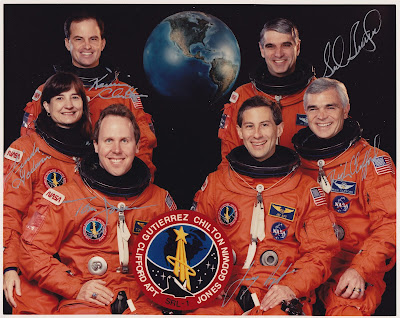

Il a écrit en 2006 SKY WALKING, ses mémoires. C'est le livre dont il fait référence au cours de cette interview.

Il a également son propre site internet


Interview réalisée en 2009

How many years were you connected to the space program before your 1st flight ?
See details in my book ''Sky Walking'' at my website : http://www.astronauttomjones.com/. Researcher since 1985, joined NASA in 1990. First flight in 1994.

How did you feel prior the flight ?
Eager to go, prepared, but nervous about whether I would be able to perform well in the space environment.
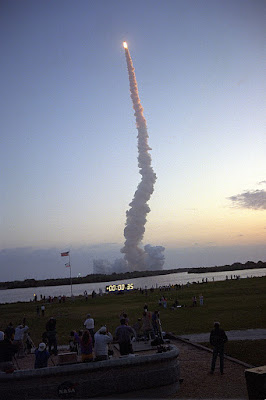
What kinds of sensations did you experienced during take-off ?
See ''Sky Walking'' -- tremendous sense of acceleration, at being hurled into space by a marvelous machine.

What does weightlessness feel like, and what did you think about the flight ?
During relaxed moments, it feel like floating on your back in a deep pool of warm water. Getting the job was my 1st priority. The view is what I enjoyed consistently.

What were some of the problems have you encountered and how did you fixed them ?
See ''Sky Walking''. Few problems; most were ably solved by the ground team. Our biggest worry for the first few days was a water system that ingested cabin air and mix air bubbles with our water. Not very good for the digestion.

What did you eat, and did it taste real ?
Favourite entree : ''Fiesta Chicken'' -- Thermo-stabilized chicken in a spicy salsa sauce. Very good.

What was Re-entry like ?
See ''Sky Walking'' for details, but I very much enjoyed the spectacular light show of the plasma wrapped around the shuttle, and the anticipation of our landing back home, with our families watching.

Were you glad to be back on Earth, or did you feel you could have spent the rest of your life up there ?
I enjoyed returning to Earth. Space travel is a hard work ! I needed a vacation !

Crédit : Collection Stéphane Sebile / Spacemen1969
             Space Quotes - Souvenirs d'espace

mercredi 23 décembre 2009

Interview avec Brian Duffy, astronaute et Pilote / Commandant de la navette spatiale lors des missions STS-45, 57, 72 et 92


Brian DUFFY est un astronaute de la NASA sélectionné en 1985 dans le groupe 11.
Ancien pilote d'essai de l'US Air Force, il a effectué 4 missions spatiales, 2 comme pilote (STS-45 et STS-57) puis 2 en tant que Commandant (STS-72 et STS-92 (qui était le 100ème vol d'une navette).
Actuellement responsable du Programme Altaïr (le futur alunisseur) chez Lockheed Martin

Interview réalisée en 2009 et il nous parle de son 1er vol, STS-45 en 1992

How many years were you connected to the space program before your 1st flight ?
I'd been at NASA for nearly 7 years before I flew the first time.

How did you feel prior the flight ?
Very excited at the thought of leaving the planet, and I felt lucky and privileged to be doing what I was doing.

What kinds of sensations did you experienced during the take-off ?
Amazing acceleration that didn't stop. The g's varied during the profile, but they were very impressive.

What does weightlessness feel like, and what did you think about during the flight ?
It feels pretty normal, particularly after being in space for a couple of days. I loved looking at Earth and I thought of my family quite a bit.

What were some of the problems you encountered and how did you fixed them ?
No real problems on my first flight, just routine things.

What did you eat and did it taste real ?
A : We choose our own menu and it differs by meal and by day. I enjoyed the food, particularly the shrimp cocktail because it was very spicy.

What was Re-entry like ?
Coming back in to land is like nothing you've ever seen or done......it's surreal what you see and feel.
Were you glad to be back on Earth, or did you feel you could have spent the rest of your life up there ?
I was glad to be back to see my family, but anxious to go again (which I did 3 more times). I'd go back to space in a minute.

mercredi 16 décembre 2009

RENCONTRE AVEC JOHN YOUNG, astronaute et Moonwalker / Gemini 3, 10 - Apollo 10, 16 et STS-1, 9


On ne présente plus un des plus célèbres astronautes au monde... Une carrière de 40 ans à la NASA... Un destin spatial exceptionnel et hors du commun.
6 vols spatiaux à son actif. 2 voyages vers la Lune dont un où il ''campera'' 3 jours. Il est le commandant de la première mission de la navette spatiale.


Les questions ont été posées en français et les réponses ont été traduites par mon grand-père lors de ma première rencontre avec John Young lors de sa visite au Salon du Bourget.

Au décollage, quelles différences y-a t-il entre un décollage de navette (STS-1), d'une Saturn V (Apollo 10 et 16) et d'une Titan (Gemini 3 et 10) ?
Lors d'un décollage de navette, cela vibre beaucoup moins... 
La Saturn V mettait plus de temps pour décoller, presque au ralenti pour quitter le sol... Nous encaissions 4-5g. Avec la navette, nous encaissons environ 3g. La navette est étudiée pour que des personnes en bonne condition physique puisse aller dans l'espace même si elles ne sont pas astronautes de métier.
La Saturn V mettait environ 12 minutes pour vous mettre en orbite contre 8 pour la navette. Malgré son imposante taille, la Saturn V n'accélérait pas aussi vite que la navette...
Mais elle était tres bruyante. Nous entendions très difficilement le Control Center... Et comme je le disais, cela vibrait beaucoup plus que dans la navette, beaucoup plus... Il était très difficile de lire les cadrans.
La Titan, elle, vibrait aussi beaucoup et nous encaissions 6-7g au décollage à cause du rapport poussée/poids.

Vous qui avez eu la chance de piloter le Module de Commande et le LEM, qu'avez vous préférer piloter ?
Le LEM bien sûr (rires) car cela voulait dire que j'allais enfin sur la Lune (rires)...
Piloter le LEM c'est un peu piloter un hélicoptère... Très complexe et difficile à piloter, mais plus ''intéressant'' que le Module de Commande où énormément de manoeuvres et d'opérations étaient un peu plus automatique... 
Beaucoup de phases de vol en Module de Commande pourraient se comparer à du vol de nuit en avion, vol sans instruments... Mais lors de manoeuvres complexes, nous prenions nos mesures visuellement sur les étoiles...pour ne pas nous tromper dans nos alignements.


Quels souvenirs gardez-vous de votre périple sur la Lune ?
Nous avons eu, jusqu'à pratiquement l'alunissage, plein de problèmes techniques. 
Le contrôle au sol a même pensé, à un moment, annuler l'alunissage (problème d'allumage secours du moteur du LEM)... Mais finalement, nous avons été jusqu'au bout, et nous avons accompli une extraordinaire mission...

Dormir sur la Lune a été très cool. Beaucoup plus agréable qu'en apesanteur totale.

Conduire la Jeep sur la Lune a été aussi un grand moment. C'est comme conduire un voiture sur la glace. Si on ne fait pas attention, on dérape très vite et on se retrouve dans l'autre sens.

Puis surtout, sauter sur la Lune... Jumper était très rigolo. Même avec nos combinaisons pleines, on pouvait sauter très haut. Regardes la photo que tu m'as amenée, tu verras que je saute très haut quand je salue sur la Lune.

Quelle a été votre réaction lorsque vous avez appris que vous iriez marcher sur la Lune ?
En fait, je n'ai pas beaucoup réagi... J'avais déjà été vers la Lune (rires...) et lorsque l'équipage d'Apollo 13 a été sélectionné, j'étais la doublure de James Lovell. Donc pas de surprises... La rotation faisait que j'embarquerai vers la Lune et marcherai dessus... 
Ce n'est qu'avec l'approche du lancement que j'ai commencé à me dire que je vivais une expérience extraordinaire comme pilote.


Merci John Young

Depuis, j'ai rencontré 4 autres fois John Young... Et je l'adore toujours autant


Crédit : Stéphane Sebile / Spacemen1969

mardi 8 décembre 2009

Interview avec Ken Cockrell, astronaute et Pilote / Commandant de la navette spatiale lors des missions STS-56, 69, 80, 98 et 111


Kenneth ''Ken'' Taco COCKRELL est un astronaute de la NASA sélectionné en 1990 dans le groupe 13.

Ancien pilote d'essai de l'US Navy, il a effectué 5 missions spatiales dont 3 en tant que Commandant de mission (STS-56, STS-69, STS-80, STS-98 et STS-111).
Actuellement, responsable du Programme WF-57F de la NASA.


Interview réalisée en 2009
Q : How many years were you connected to the space program before your 1st flight ?
A : I worked as a NASA Pilot from 1987 until 1990. I as in astronaut training from 1990 until my first flight in 1993.
 
Q : How did you feel prior the flight ?
A : Excited and little nervous - I was hoping I would not forgot anything !
 
Q : What kinds of sensations did you experienced during the take-off ?
A : It's an exciting ride ! But I felt like I had seen it all before because of the excellent simulator training.
 
Q : What does weightlessness feel like, and what did you think about during the flight ?
A : It felts like you are flying ! Flying as you dreamed it as a child !
 
Q : What were some of the problems you encountered and how did you fixed them ?
A : We had one experiment that was getting too hot. We made a duct - a long tube - out of paper and plastic, which took air from the shuttle's air conditioning and blew it on the experiment.
 
Q : What did you eat and did it taste real ?
A : I ate dried fruits and meals that I put water in and then heated in the oven. I also ate ready-to-eat meals, the same as our soldiers eat. The taste was great !
 
Q : What was Re-entry like ?
A : Very smooth, but I felt very heavy after 9 days weightless.
 
Q : Were you glad to be back on Earth, or did you feel you could have spent the rest of your life up there ?
A : I loved the flight and I also loved coming home - And I was ready to go back as soon as possible !


vendredi 4 décembre 2009

Rencontre avec Glynn S. Lunney


Glynn S. Lunney est une des figures les plus célèbres du programme spatial américain. Il est l'un des premiers Flight Director (Directeur de Vol).

Entré à la NASA en 1958, il a été de toutes les missions du Programme Mercury au début du Programme Navette. 
Il a été entre autre, un des Flight Director des missions Apollo 11 et 13. 
A la fin du Programme Apollo, il devient le Project Manager du Programme Apollo-Soyouz.

Rencontre réalisée en 2002

What is (are) your(s) best memory(ies) about your NASA Career ?
Space program has been and continue to be one of the great adventures of our human race.

I was truly fortunate to join the program as a young man just after graduated in 1958 and I had the opportunity and privilege to be part of it all of my profesional life.

As to being a flight Dorector, I was one unmanned Apollo's 201, 202 and 501 - Gemini 4, 9, 10 and 12 - Apollo 7, 8, 10, 11, 12, 13, 14 and 15.

It was extremely exciting, rewarding and great fun. 
We always had the Sense that we were exploring this new frontier, as representatives of all humankind could not - and still can't - imagine a greater opportunity.

(Photo du MCC lors d'Apollo 13 signée par Glynn Lunney, James McDivitt, Vance Brand, Gerry Griffin et Fred Haise)

Crédit : Collection Stéphane Sebile / Spacemen1969
             Space Quotes - Souvenirs d'espace

Entretien avec Robert C. Seamans, Jr


Robert SEAMANS (30 octobre 1918 - 28 juin 2008) était ingénieur en aéronautique et astronautique.
 Professeur au MIT (Massachussetts Institut of Technology), il devient Administrateur Associé de 1960 à 1965 et Directeur-Adjoint de la NASA de 1965 à 1968 après avoir travaillé au NACA dès 1948.

Après avoir quitté la NASA, il devient Secretary of the US Air Force de 1969 à 1973.
Entretien réalisé en octobre 2001
What is (are) your(s) best memory(ies) about your NASA Career ?
I arrived at NASA when Eisenhower was President just before the change in administration.
Eisenhower was unwilling to commit beyond the Mercury manned space program and until Gagarin orbited the Earth weither was Kennedy.
However by the end of may 1961, we were commited to a Lunar Landing before the end of the decade.
Lots of key decisions had to be made in a 6 month period.
It was my good fortune to there at (sept. 1, 1960) NASA at this time.
Robert Seamans a écrit un livre très instructif sur le Programme Apollo / Project Apollo - The thoughts decisions (Monographs in Aerospace History n° 37 - SP2005-4537)

jeudi 3 décembre 2009

Soyouz TMA-15 est revenu sur Terre


Le 1er décembre 2009, Soyouz TMA-15 avec à son bord l'équipage d'Expedition 20/21 revenait sur Terre.
Frank De Winne (ESA-Belgique), Roman Romanenko (Russie) et Robert Thirsk (Canada) ont décollé le 27 mai 2009.
Ils reviennent sur Terre après avoir passé 187 jours 20 heures et 41 minutes de vol.


mercredi 2 décembre 2009

Interview avec John Glenn, premier américain en orbite lors de la mission Friendship 7

John Glenn, un des 7 astronautes du Programme Mercury, a effectué son premier vol spatial le 20 février 1962 à bord de la capsule Friendship 7, devenant le 1er américain en orbite. Par la suite, il quitte la NASA et devient Sénateur... En octobre 1998, il effectue son 2ème vol à bord de la navette spatiale Discovery lors de la mission STS-95, et devient ainsi, la personne la plus agée ayant effectué un vol spatial (77 ans)
Interview effectuée en 1987
Q : How many years were you connected to the space program before your 1st flight ?
A : I selected in april 1959. After the first two years of training, we were ready to go space but that was delayed while the equipment was developed. I made the first orbital US flight on february 20, 1962 with Friendship 7 spacecraft
Q : How did you feel prior the flight ?
A : I was not afraid. I looked forward the mission and hurry to learn everything about the astronaut reaction in space
Q : What kinds of sensations did you experienced during take-off ?
A : Lift off was very gentle because the tremendous weight of the booster barely exceeded the trust of rockets. On the Mercury missions, insertion into orbit was made at about 8G's and re-entry had an approximate 8G deceleration.
Q : What does weightlessness feel like, and what did you think about during the flight ?
A : I found weightlessness very pleasant. But I did't float around the capsulme because we kept our straps in place. The cockpit space was very small...
In space it's completly black, even when the sun is shining. You can't see the blue sky. The view from 160 miles in altitude was fantastic...
Q : What were some of the problems you encountered and how did you fixed them ?
A : The automatic control systems wasn't functioning properly and I took the manual control during the 2nd and 3rd orbits and during the re-entry.
Another problem was a signaeled sent to the ground indicating my heat shield was loose. To make sure it was secured during re-entry, I kept retrorocket pack in place. Fortunatly, it was a mistake message... So, if it was good, I was not here to be answering questions today...
Q : What did you eat and did it taste real ?
A : I took numbers of kind of food, all emulsified like baby food. No problem eating.
Q : What was Re-entry like ?
A : With 8G's forces and with the problem of heat shield and as I kept the retrorocket pack, I was very busy. During the re-entry, some large portions of burning retrorocket pack came flying by the window...
Q : Were you glad to be back on Earth, or did you feel you could have spent the rest of your life up there ?
A : I was glad to be back. But I think it would be great to go on a mission every day...

jeudi 26 novembre 2009

RENCONTRE AVEC BUZZ ALDRIN / Paris le 26 novembre 2009


Cet après-midi, à l'Institut d'Astrophysique de Paris se tenait une Conférence Internationale en hommage à l'astronome Ouzbek Mirzo Ulughbeg...
L'invité d'honneur était BUZZ ALDRIN, lui-même...
 
(Crédit Photos : Stéphane Sebile / Space Quotes - Souvenirs d'espace)

mercredi 25 novembre 2009

Passage de la Station Spatiale Internationale et de la navette spatiale Atlantis

Ce soir, à 18h12, l'ISS suivie de la navette spatiale Atlantis (STS-129) sont passés au-dessus de la France. Ici, un petit extrait de ce qui était visible à Dugny (93) entre les nuages. Atlantis suit l'ISS (donc à sa droite). Film réalisé avec un appareil photo qui n'est optimum en vidéo.


Interview avec Jerry Carr, commandant de la mission Skylab 4


Jerry Carr est sélectionné comme astronaute par la NASA en 1966. Il effectuera une mission spatiale en tant que commandant de Skylab 4 et restera 84 jours dans l'espace du 16 novembre 1973 au 8 février 1974.

Interview réalisée en 2001


How many years were you connected to the space program before your 1st flight ?
About 8 years

How did you feel prior the flight ?
Anxious and exhilarated


What does weightlessness feel like, and what did you think about during the flight ?
Like floating in water. 
I think about the fragility of the Earth's environment and the insignificance of the Earth in the Cosmos.


What were some of the problems you encountered and how did you fixed them ?
Refer to a book entlited ''SKYLAB'' of David Shayler. 
Book will be published soon by Springer-Praxis

What did you eat and did it taste real ?
We had a large menu. Many tasty items. Our sense of taste was somewhat reduced

What was Re-entry like ?
VERY FIREY. We had a partial control systems failure but the back ups worked well


Were you glad to be back on Earth, or did you feel you could have spent the rest of your life up there ?
Yes. I was ready to rejoin my family and friends

Crédit : Collection Stéphane Sebile / Spacemen1969
             Space Quotes - Souvenirs d'espace

Interview avec Bonnie Dunbar, astronaute lors des missions STS-61A, 32, 50, 71 et 89


Bonnie Dunbar est astronaute de la NASA et elle a effectué le plus grande nombre de missions spatiales pour une femme (avec Shannon Lucid et Marsha Ivins).
Elle est scientifique et médecin.
Elle entre à la NASA en 1978 en tant que Flight Controller et Payload Officer.
Elle est sélectionnée en 1980 dans le Groupe 9).
Elle effectue son premier vol spatial lors de la mission STS-61A du 30 octobre au 6 novembre 1985.
Elle effectuera 5 missions spatiales (STS-61A, 32, 50, 71 et STS-89). Elle quitte la NASA en 2005.
Actuellement Présidente et Directrice du Museum of Flight de Seattle.

 
Interview réalisée en 2001
How many years were you connected to the space program before your 1st flight ?
I was with the Space Program 5 years as astronaut and 6 years as engineer before my first flight on the space shuttle
 
 
How did you feel prior the flight ?
Great !
 
 
What kinds of sensations did you experienced during the take-off ?
Up to 3g during the 8-minutes launch. But since we were lying on our backs, this was not significant
 
 
What does weightlessness feel like, and what did you think about during the flight ?
Weightlessness was wonderful !!! I ought about the experiments and how lucky I was
 
 
What were some of the problems you encountered and how did you fixed them ?
I encountered problems with some of experiments, and fixed them by rewiring hardware and re-loading sofware
 
 
What did you eat and did it taste real ?
All the food is very good - like schrimp cocktail, beef barbecue, chicken, etc...
 
 
What was Re-entry like ?
It least about 50 minutes. At night it was possible to see the glow of plasma re-entry
 
 
Were you glad to be back on Earth, or did you feel you could have spent the rest of your life up there ?
I was glad to be back on Earth, but would like to spend more time on-orbit